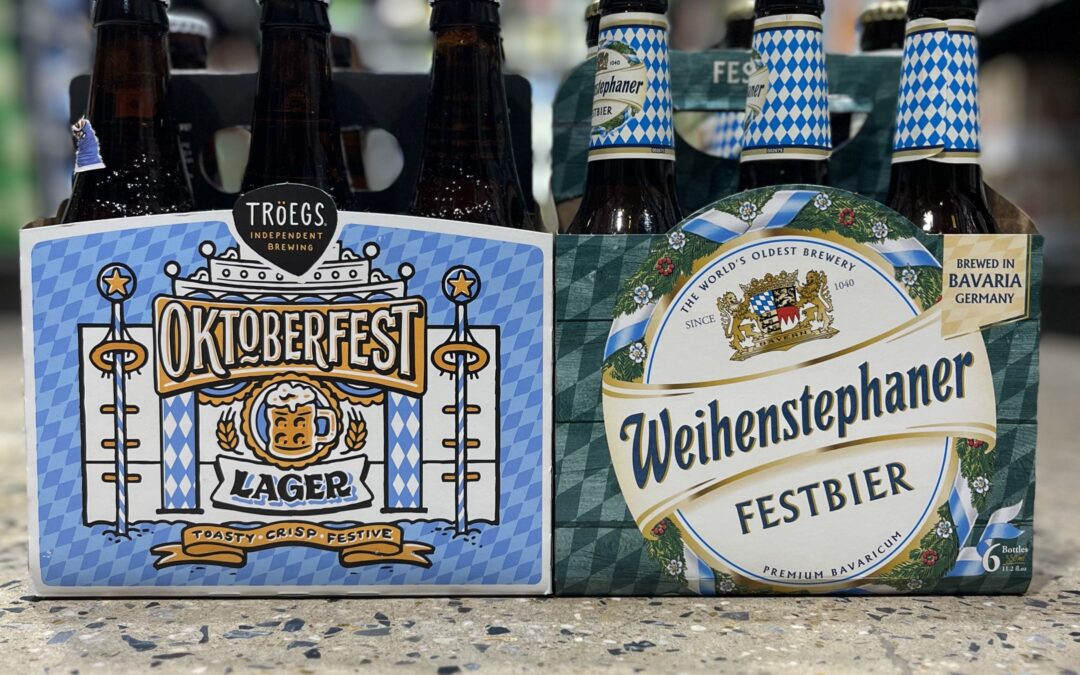
Walk into a beer store in September and you’re going to see a lot of beers called Oktoberfest.
Some will be deep amber. Others will be pale gold. Some will taste heavily of toasted bread and malt, while others will be clean, and make the haters say “that’s not half bad”.
So are they all the same beer?
Not exactly.
The confusion mostly comes down to two German lager styles: Märzen and Festbier. Both are closely tied to Oktoberfest, both are malty, and both usually land somewhere around 6% ABV. But put the two next to each other and the differences become pretty obvious.
And if you’re wondering why your favorite Oktoberfest beer looks nothing like the one sitting next to it, this is probably why.
Märzen: The Amber Oktoberfest Beer
Märzen is the beer most Americans probably picture when they hear “Oktoberfest.”
It’s amber to copper in color, with a richer malt character and a little more body. The flavor tends to lean toward toasted bread, fresh-baked crust and lightly nutty malt rather than caramel sweetness.
That last part is worth pointing out. The malt can be rich without becoming heavy or sugary. The bitterness stays fairly restrained, but it provides enough balance to keep the beer from feeling sweet. Historically, Märzen was a stronger lager brewed in March and then stored, or lagered, through the warmer months. The name literally comes from the German word for March.
That long storage was important in the days before modern refrigeration. Brewers needed to get the beer made while conditions were cold enough for lagering. By the time fall rolled around, the beer was ready for drinking. There’s a pretty nice bit of history hiding in that name. Märzen eventually became closely associated with Oktoberfest, and the amber style was served at the festival for generations. That changed in 1990.
Festbier: The Modern Oktoberfest Beer
If Märzen is the richer, amber version, Festbier is its lighter, paler cousin.
Festbier is golden, clean and smooth. It still has plenty of malt flavor, but the malt is more delicate. Instead of a heavy toasted character, you’ll often get flavors that remind you of fresh bread or cracker.
It’s also designed to be incredibly drinkable.
That matters when you’re talking about Oktoberfest. The modern Munich festival isn’t exactly a place where people sit down with one 8-ounce tasting glass and slowly analyze their beer. Festbier needs enough flavor to stand on its own while remaining easy to drink over the course of a long afternoon.
The BJCP describes Festbier as a pale German lager that balances malt richness with drinkability. It also notes that the modern style became the standard beer served at Munich’s Oktoberfest beginning in 1990.
So if you’ve ever had an Oktoberfest beer in Germany and thought, “This is way lighter than the Oktoberfest beers I usually drink,” you weren’t imagining it.
So Which One Is Actually Oktoberfest Beer?
Here’s where things get confusing.
At Oktoberfest in Munich, the beer served by the major Munich breweries is the modern golden Festbier style. The official festival runs from September 19 through October 4 in 2026, and the beer served there follows rules tied to Munich’s brewing tradition and the festival itself. Outside Munich, things get much looser.
American breweries frequently use “Oktoberfest” for beers modeled after the traditional amber Märzen style. German breweries also export amber Oktoberfest-style beers to the United States.
There’s even a legal distinction behind some of the terminology. “Oktoberfestbier” is a protected designation for beer produced by qualifying breweries within Munich for Oktoberfest, while American breweries aren’t bound by those rules. That’s why you can walk into an American beer store and find ten “Oktoberfest” beers that don’t look or taste exactly alike.
They’re not necessarily trying to trick you. They’re just drawing from different parts of the style’s history.
Festbier vs. Märzen: The Quick Comparison
| Festbier | Märzen | |
|---|---|---|
| Color | Pale gold | Amber to copper |
| Malt | Moderate, bready, cracker | Richer, toastier, bready |
| Body | Medium, smooth | Medium, fuller |
| Bitterness | Moderate-low | Moderate |
| ABV | Around 5.8–6.3% | Around 5.6–6.3% |
| Overall feel | Crisp and highly drinkable | Richer and more malt-forward |
Neither is necessarily “better.” That’s the fun part.
A Festbier is probably the better choice if you want something that disappears from your glass a little too quickly. Märzen is the move if you want more malt flavor and a beer that feels a little more substantial.
Five Styles to Try If You Like Oktoberfest Beer
The fun doesn’t stop at Festbier and Märzen. These beers sit in a larger family of malty European lagers, and there are some pretty easy directions to go from here.
1. Vienna Lager
Vienna Lager is one of the closest relatives to Märzen.
It’s amber, smooth and malt-forward, but usually a little lighter. The style has a distinct toasted malt character without becoming overly sweet or heavy.
If you like the bready, toasty side of Märzen, this is an easy next step.
2. Munich Helles
Want to go in the opposite direction?
Try a Munich Helles.
Helles is pale, clean and malt-forward, but it’s generally lighter and less intense than Festbier. Think of it as a great beer for someone who likes the malt character of German lagers but doesn’t necessarily want a “fall beer.”
It’s also a good reminder that German lager isn’t one flavor profile. A beer can be pale and malt-forward without being bland.
3. Kellerbier
Kellerbier is a little different.
The name roughly translates to “cellar beer,” and the style is traditionally associated with beer served relatively young and less filtered. That can give it a fuller, sometimes slightly hazy appearance and a more rustic character.
Compared with Festbier and Märzen, Kellerbier can feel less polished and more brewery-to-glass.
If you like the idea of German lager but want something with a little more personality, keep an eye out for Weihenstephaner.
4. Munich Dunkel
Now we’re getting darker.
Munich Dunkel brings more roasted and deeply malty flavors than either Festbier or Märzen, although it shouldn’t taste like a stout or porter. Think toasted bread, chocolate-like malt and a rich but still drinkable lager character.
It’s a great cold-weather beer without being a heavy beer.
5. Helles Bock
If you like Oktoberfest beer but want more of everything, look for Helles Bock.
It’s stronger, richer and more intense than Festbier. You get a bigger malt presence and more alcohol, while the beer still maintains the clean character you’d expect from a German lager.
This is the beer to reach for when a 6% Festbier just isn’t quite doing enough.
Why Do We Call All of These “Oktoberfest” Beers?
Honestly, because beer naming is messy.
American beer culture has taken the Oktoberfest tradition and run with it. Some breweries make amber Märzen-style beers. Others make pale Festbier-style beers. Some simply use the word “Oktoberfest” because customers understand what it means.
And that’s not necessarily a bad thing. It gives us a pretty great excuse to try a bunch of different German lagers every fall.
If you want the modern Munich experience, grab a Festbier. If you want the richer amber version that many Americans associate with Oktoberfest, go Märzen. If you’ve already found your favorite, branch out from there. That’s probably the best part of seasonal beer.
You don’t have to pick one and declare a winner.
You can just keep drinking your way through the season.
Facebook Comments